

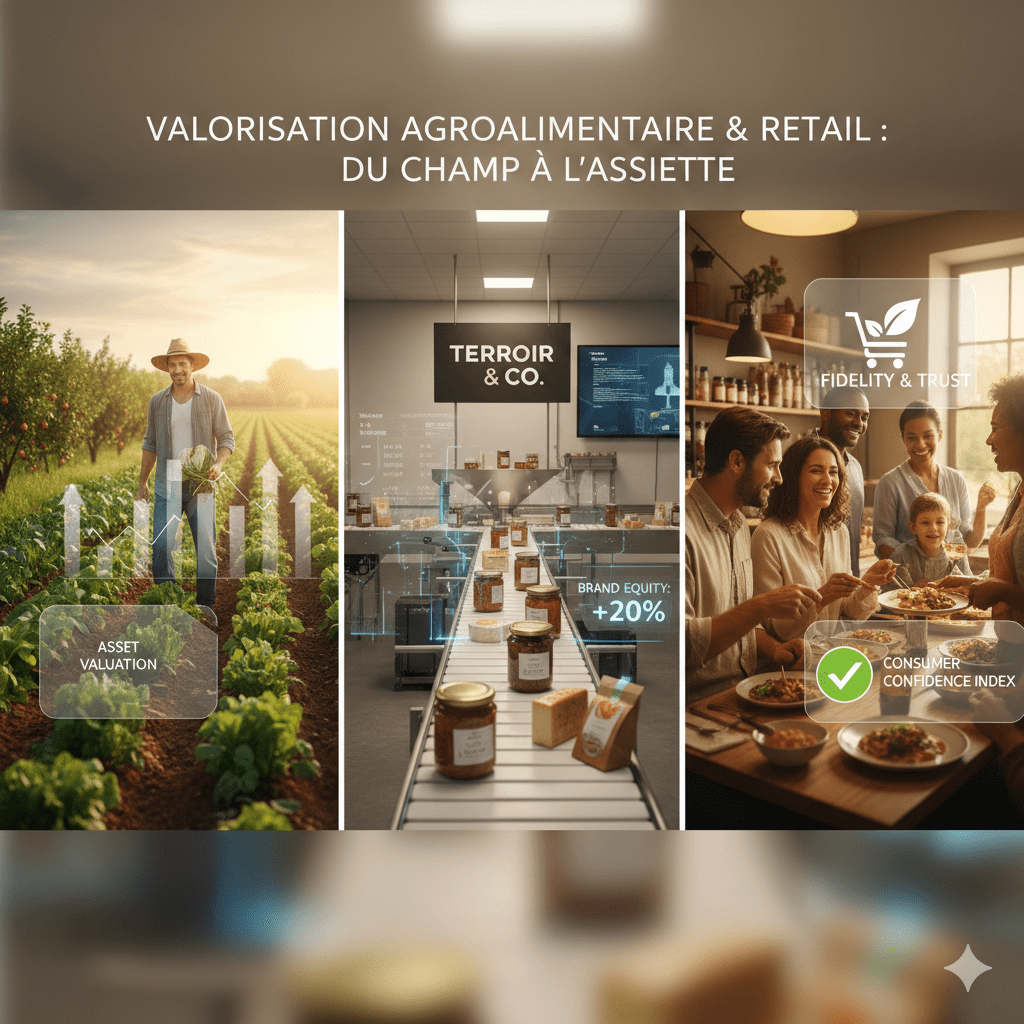


In the agri-food and retail sectors, value does not lie solely in product quality or retail space, but in the trust consumers place in the brand. Analysis of our engagements over the 2017–2025 period ranks this sector fifth among our activities, with a notable acceleration in the past two years.
Whether dealing with large cooperatives restructuring their assets or regional brands with strong identity, financial valuation must capture customer loyalty and the strength of the distribution network. The following outlines the observed trends and methodologies.
1. Restructuring Brand Portfolios
A major trend recently observed is the reorganization of intangible assets within large agricultural groups. The objective is often to streamline the portfolio by transferring brands to dedicated entities within the group.
Relief from Royalty approach: This is the leading method in this sector. For a major agricultural cooperative, we valued several distinct brand portfolios, including consumer gardening, professional distribution, and frozen products, in preparation for internal transfers.
Precise segmentation: The key issue is to define royalty rates tailored to each segment. Our analyses validated brand values ranging from a few hundred thousand euros for niche brands to more than €5 million for leading consumer distribution brands in their regional markets.
2. The Premium for “Organic” and “Terroir.”
The valuation of food products increasingly depends on their ethical or premium positioning. The brand becomes a quality label that justifies a higher valuation.
Quality-labeled products: We were engaged to value a brand of organic fruit with strong international protection. The combined use of historical costs and future cash flows supported a valuation close to €3 million, reflecting both marketing investment and the price premium accepted by consumers.
Exceptional and luxury food products: For prestigious wine estates, the discounted cash flow method is preferred to capture the economic rent. For an ultra-premium wine brand, valuation exceeded €6 million, demonstrating that in luxury agri-food, the brand carries as much weight as the land itself.
3. Valuing the Business Unit and the Network
In retail, the brand is inseparable from the distribution network. Our assignments often involve isolating the value of an entire business unit, including goodwill, brand, and know-how.
Global approach: For a company in aquaculture and animal nutrition, the valuation of the brand, estimated at over €15 million, had to account for its use across several European markets, including Greece and Spain, and its ability to generate revenue in B2B segments.
Specialized distribution: Whether in garden center networks or producer stores, valuation depends on the brand’s ability to build a captive customer base. Comparable market analysis, EV/EBITDA multiples, is frequently used to support income-based approaches.
4. Methods: Between Costs and Revenues
Unlike the tech sector, where revenue multiples dominate, agri-food requires a more asset-based and cautious approach.
Replacement cost: This method is often used as a “floor value” for secondary or regional brands, such as private labels or specific product ranges. It estimates the cost required today to rebuild equivalent brand awareness.
Discounted cash flows: This remains essential for mature assets generating recurring and predictable revenues, typical of food consumption.
Conclusion
Valuing an asset in the agri-food sector requires understanding the entire value chain, from production, including plant patents and agricultural know-how, to the consumer’s plate, including brand and distribution network. As illustrated by our work on pastry brands and wine trading companies, the financial expert must be able to translate taste and terroir into robust economic equations.
