

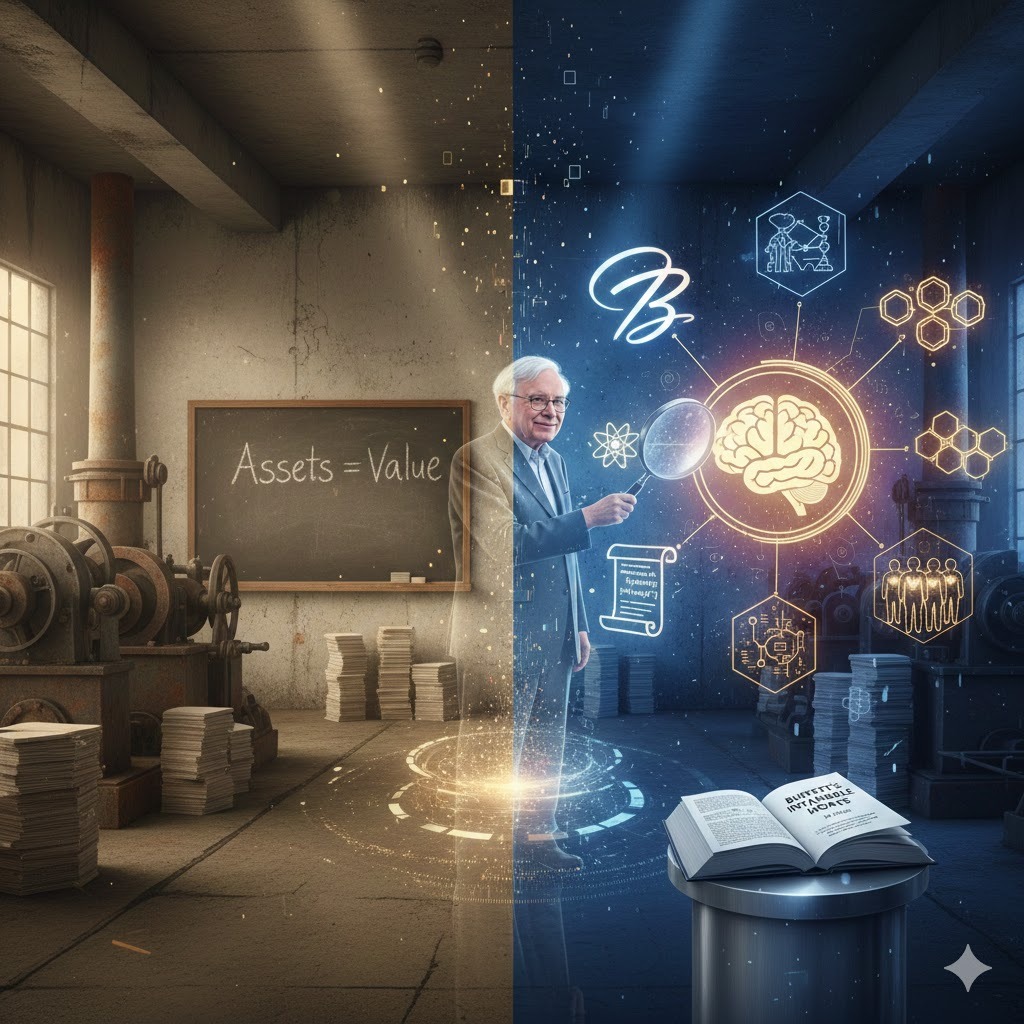


In the world of traditional accounting, a factory is worth gold, but a brand, a patent, or a corporate culture is often worth… nothing, or at least very little. Yet a comprehensive quantitative study conducted by Kai Wu (Buffett’s Intangible Moats, Sparkline Capital) mathematically demonstrates that the modern economy no longer runs on machines, but on the invisible.
If valuing intangibles still seems vague or reserved for a niche of experts, the data from the research article Buffett’s Intangible Moats (July 2025) challenges that perception. The real value has shifted to the other side of the mirror.
The Accounting Paradox: Paying 8 Dollars for 1 Dollar of Assets
For decades, investors were taught to buy companies priced close to their “book value” (the net value of tangible assets such as inventory and property). That was the old school.
Kai Wu’s analysis shows that this approach is now obsolete. By examining the portfolio of Warren Buffett—often mistakenly viewed as a champion of “tangible value”—Wu uncovered a striking statistic:
- 92% of Buffett’s positions were acquired at prices above their book value.
- On average, he paid 7.9 times the value of tangible assets to acquire stakes in high-quality companies.
Why pay such a premium? Because Buffett understood that the balance sheet no longer captures the company’s true cash-generating engine.
The Four Pillars of Intangible Capital
If value is not in physical assets, where is it? Wu’s study offers a clear framework for identifying and valuing these “ghost assets,” dividing intangible capital into four categories:
- Brand Equity: The ability to retain customers and command pricing power. Example: when Buffett acquired Coca-Cola in 1988, he paid 4.1 times book value. In the 1990s, the market valued this intangible strength at up to 22 times tangible assets.
- Human Capital: The skills, alignment, and motivation of teams—central to financial services and consulting firms.
- Intellectual Property (IP): Patents, proprietary data, and technological know-how.
- Network Effects: The more users a service has, the more valuable it becomes—the strongest “moat” in the digital economy.
The shift is clear: in 1978, Buffett’s portfolio was largely based on tangible assets. By 2024, it is dominated by intellectual property (notably through Apple Inc.) and brand capital.
The Mechanics of “Future Quality”
The most compelling contribution of Wu’s research is explaining why investing in intangibles is profitable. He distinguishes between two key concepts:
- Quality: Companies that are profitable today.
- Intangible Value: Companies that invest in R&D, marketing, or training, sacrificing short-term profits.
Wu demonstrates that these expenditures, often treated as costs by accountants, are in fact investments that create “future quality.” Companies with high intangible value tend to see their profitability (ROE) surge over the following 5 to 10 years.
Proof in Numbers: 87% of Performance Explained
Does intangible valuation actually work? Wu’s model provides a clear answer. By analyzing the historical outperformance of Berkshire Hathaway (3% annually above the S&P 500 since 1978), he concludes:
- 87% of this outperformance is mathematically explained by systematic exposure to quality and intangible factors.
- Once these factors are removed, the unexplained “genius” (alpha) drops to just 0.4% per year.
Moreover, a simple portfolio composed of 50% “quality” stocks and 50% “high intangible value” stocks would have replicated—or even exceeded—the performance of the legendary investor in recent years.
The remaining 13% may reasonably be attributed to Buffett’s intuition.
Key Takeaways
- Do not assess a company based on its physical assets. In a modern economy, a company without factories can be more resilient than an industrial giant, provided it possesses intangible “moats” (brand, patents, networks).
- Intangibles can be measured. This is not intuition—it is financial data that, when combined with fundamental quality, becomes the most powerful long-term driver of value creation.
As Buffett stated in 2018 about technology giants: “They don’t need any net tangible assets to generate their earnings.” Valuation methods must now align with this reality.
