

In classical computing, silicon has reigned supreme for decades. In the quantum sector, we are still far from such a consensus. The OECD and EPO study published in December 2025 reveals an ecosystem in a state of flux, marked by intense experimentation across multiple hardware platforms.
For investors and valuation experts, this lack of a dominant standard represents both a major risk and a unique strategic opportunity.
1. An Ecosystem Still Searching for its “Paradigm”
Unlike other more mature technological sectors, quantum is characterized by low overall technological maturity. The study identifies at least 12 different hardware platforms currently being explored to achieve and control the phenomena of superposition and entanglement.
This diversity of approaches shows that the industry has not yet converged on a single paradigm. For asset valuation professionals, this means that the value of a patent today depends heavily on the survival of the technological platform to which it is linked.
2. The Battle of Infrastructures: Cryogenics vs. Ultra-High Vacuum
Each platform relies on radically different physical principles and infrastructure requirements:
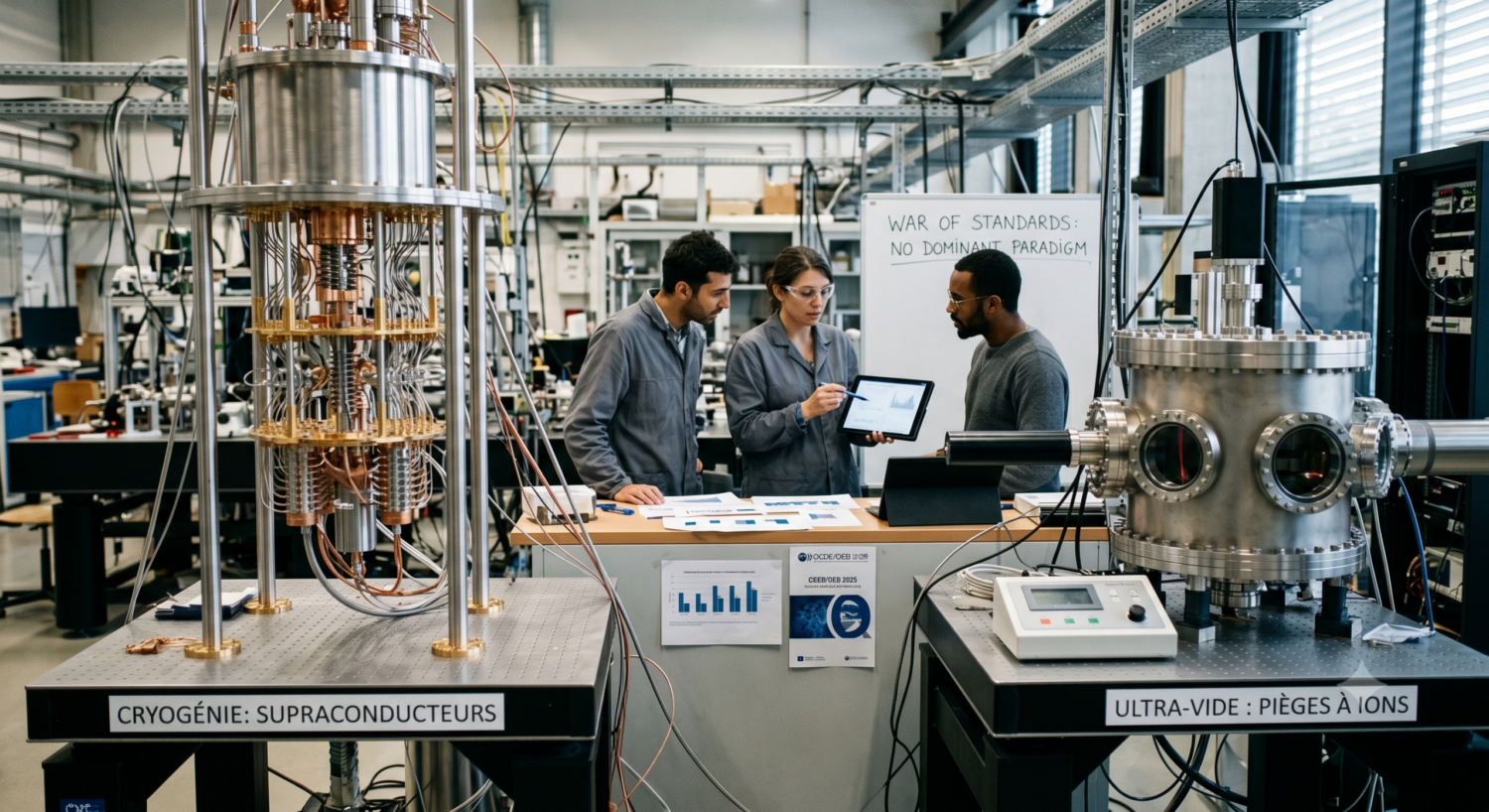
- Extreme Cold (Cryogenics): Superconducting circuits (used by IBM or Google) and quantum dots require temperatures near absolute zero (millikelvin) to function.
- Absolute Vacuum (UHV): Ion traps or neutral atoms require ultra-high vacuum chambers to prevent air particles from interfering with the qubits.
- The Valuation Stake: Platforms capable of operating at room temperature or utilizing standard manufacturing processes (semiconductors) offer clearer paths to scaling and are therefore potentially more valuable in the long term.
3. Who is Leading? Innovation by the Numbers
The patent landscape reflects this competition between platforms:
- Superconductors in the Lead: In the field of computing, superconducting technologies currently hold the advantage in terms of the volume of International Patent Families (IPFs).
- The Rise of Computing: While quantum communication dominated for a long time, quantum computing has become the most dynamic area, surpassing other fields in the number of annual filings since 2022.
- Hyper-growth: Patents in quantum computing have increased nearly 20-fold since 2014, compared to a 3-fold increase for communication.
4. Investment Strategy: Not Putting All Your Eggs in One Basket
Faced with this uncertainty, investors and governments are adopting a risk diversification strategy.
- Funding Peak: Interest remains massive, with fundraising reaching nearly $5 billion in 2024.
- The Role of Corporate Venture Capital (CVC): The share of CVC in quantum (8% between 2019-2021) is double the general average, proving that tech giants want to keep a foot in every potentially winning platform.
Conclusion: Valuing Technological Agility
In this context of a “standards war,” the valuation of intangibles cannot rely solely on a quantitative analysis of patents. It must integrate the industrial viability of the hardware architecture. The “core” firms in the sector—58% of whose founders hold PhDs—are precious assets because they hold not only the IP but also the critical know-how to navigate this uncertainty.
In 2025, investing in quantum means accepting a bet on several horses, while closely monitoring which one will be the first to cross the barrier of industrialization.
Source: OECD/EPO (2025), “Mapping the global quantum ecosystem: A comprehensive analysis based on innovation, firm, investment, skills, trade and policy data.”