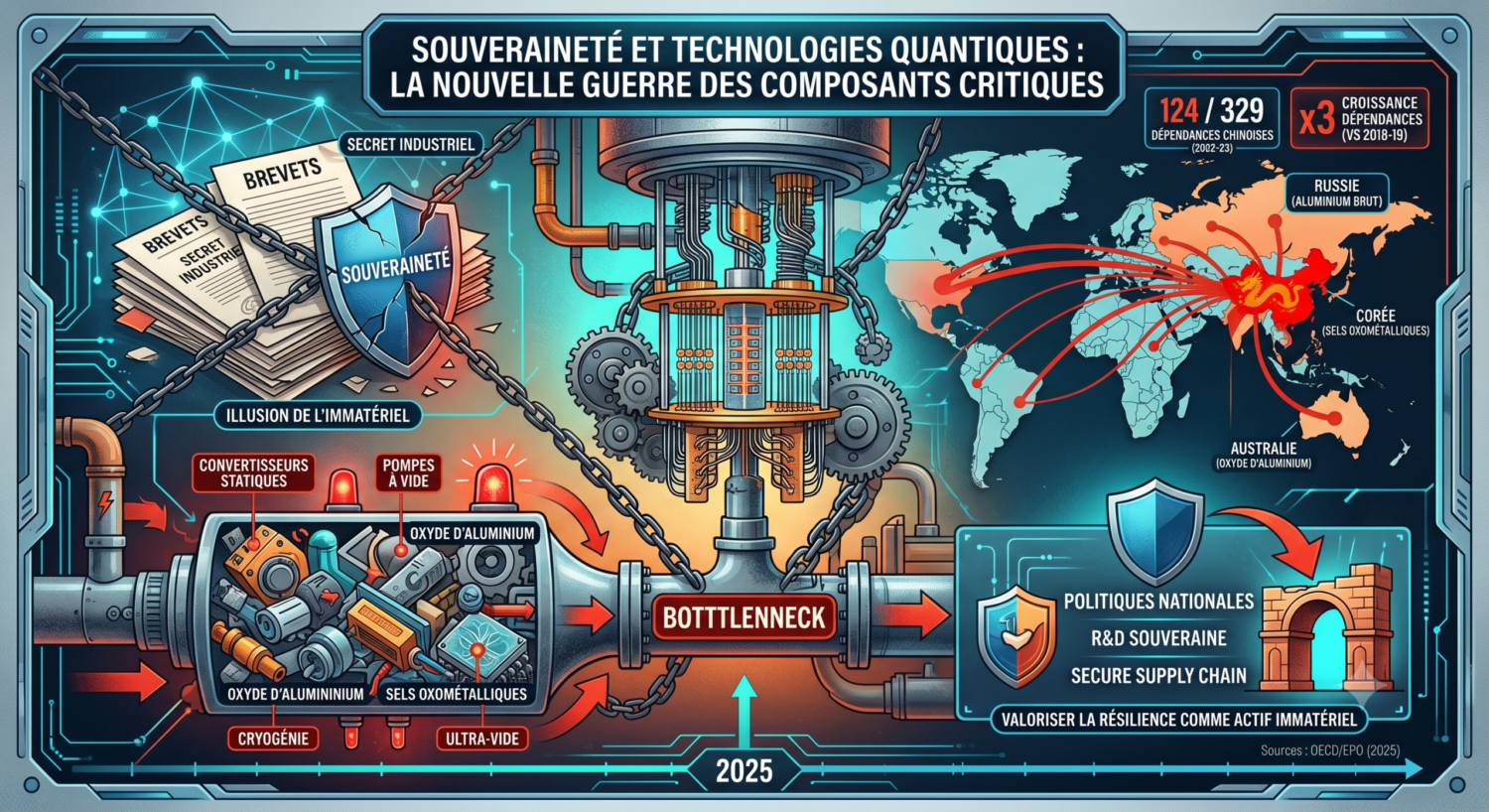


In the global race for innovation, the valuation of intangibles (patents, trade secrets, human capital) takes on its full significance in the field of quantum technologies. However, a major study published in December 2025 by the OECD and the EPO serves as a reminder of a brutal physical reality: without secure control over the supply chain, the value of these intangible assets risks remaining purely theoretical.
For investors and executives, understanding the vulnerabilities of the quantum supply chain is now an essential component of risk management and sovereignty strategy.
The Illusion of the Intangible: When Hardware Dictates the Terms
While quantum technologies promise to revolutionize computing and cryptography, they rely on physical infrastructures of extreme complexity (cryogenics, ultra-high vacuum, photonics). The study reveals that the ability to transform a patented idea into a finished product depends on a handful of strategic global suppliers.
This dependency creates a systemic vulnerability: a top-tier patent portfolio loses value if the components necessary for its implementation are subject to export restrictions or geopolitical tensions.
Key Figures of Global Dependency
The analysis of trade flows shows an alarming concentration for certain critical inputs:
- China’s Meteoric Rise: Of the 329 trade dependencies identified in the quantum ecosystem in 2022-2023, 124 are linked to China. This figure has nearly tripled compared to the 2018-2019 period, when only 40 were recorded.
- The Converter Bottleneck: Static converters, essential for powering equipment, represent the strongest dependency. 50 economies depend on a single strategic partner, and in nearly 40 of those cases, that supplier is China.
- Hyper-Concentrated Resources: The supply chain is dotted with geographic monopolies or oligopolies. Australia is the global pivot for aluminum oxide, while Russia remains a key supplier for raw aluminum. For oxometallic salts, Korea has emerged as the most critical supplier.
Valuing “Resilience” as an Intangible Asset
In terms of valuation, this data shifts the analytical framework. The value of a “Deep Tech” company in 2025 is no longer measured solely by the size of its patent portfolio, but also by the resilience of its technological architecture.
A technology capable of operating at room temperature (such as diamond NV centers) or utilizing standard manufacturing processes (semiconductors) possesses superior intangible value, as it reduces reliance on niche infrastructures like millikelvin cryogenics.
The State Response: Toward an Economy of Protection
Aware of these risks, more than 30 countries have formulated national policies, including 18 OECD members with comprehensive quantum strategies. The objective is twofold:
- Fund R&D to maintain scientific leadership.
- Secure technological sovereignty by limiting dependencies on critical suppliers.
The valuation of intangibles in the quantum sector can no longer be disconnected from the geographical reality of components. In 2025, technological sovereignty has become an asset in its own right. For companies in the sector, the ability to demonstrate a secure supply chain is now as crucial as demonstrating a “quantum advantage” to attract capital and guarantee the long-term value of their innovations.
Source: OECD/EPO (2025), “Mapping the global quantum ecosystem: A comprehensive analysis based on innovation, firm, investment, skills, trade and policy data.”